

This week I read a LinkedIn post from a B2B marketer who stopped running TOFU, MOFU and BOFU campaigns. He runs two types now. Out-market campaigns go to the whole ICP list with high-frequency ads, so when those companies start buying, his brand is the one they remember. In-market campaigns are laser-targeted: visits to pricing and service pages, intent signals from tools like Dreamdata and G2, an ICP filter on top, and open pipeline kept inside the audience until the deal is closed.
It's a good post and he's right about a lot. B2B buying isn't linear (Gartner said the linear sales process no longer exists back in 2019). Generic retargeting is weak. Excluding open pipeline from your ads is a mistake.
But I want to add something, because I think people read posts like that and take the wrong lesson from them.
The playbooks didn't stop working. TOFU, MOFU, BOFU, brand and performance: they always worked and they will always work. What changes is the implementation, the channel and the creativity behind it. And right now, in my opinion, the top of the funnel is the most important part of the whole thing. Brand awareness isn't a "nice to have" anymore. It's where B2B gets won.
Let me explain why.
The Short Version
- Only around 5% of B2B buyers are in-market at any moment (the 95:5 rule), and almost everyone fights for that same group with the same playbook.
- A few years ago demand was waiting to be filled. Today there's a tool for every gap, so demand has to be created.
- Demand appears when a problem becomes visible, close and urgent. Good top-of-funnel marketing makes the problem visible before the fire happens.
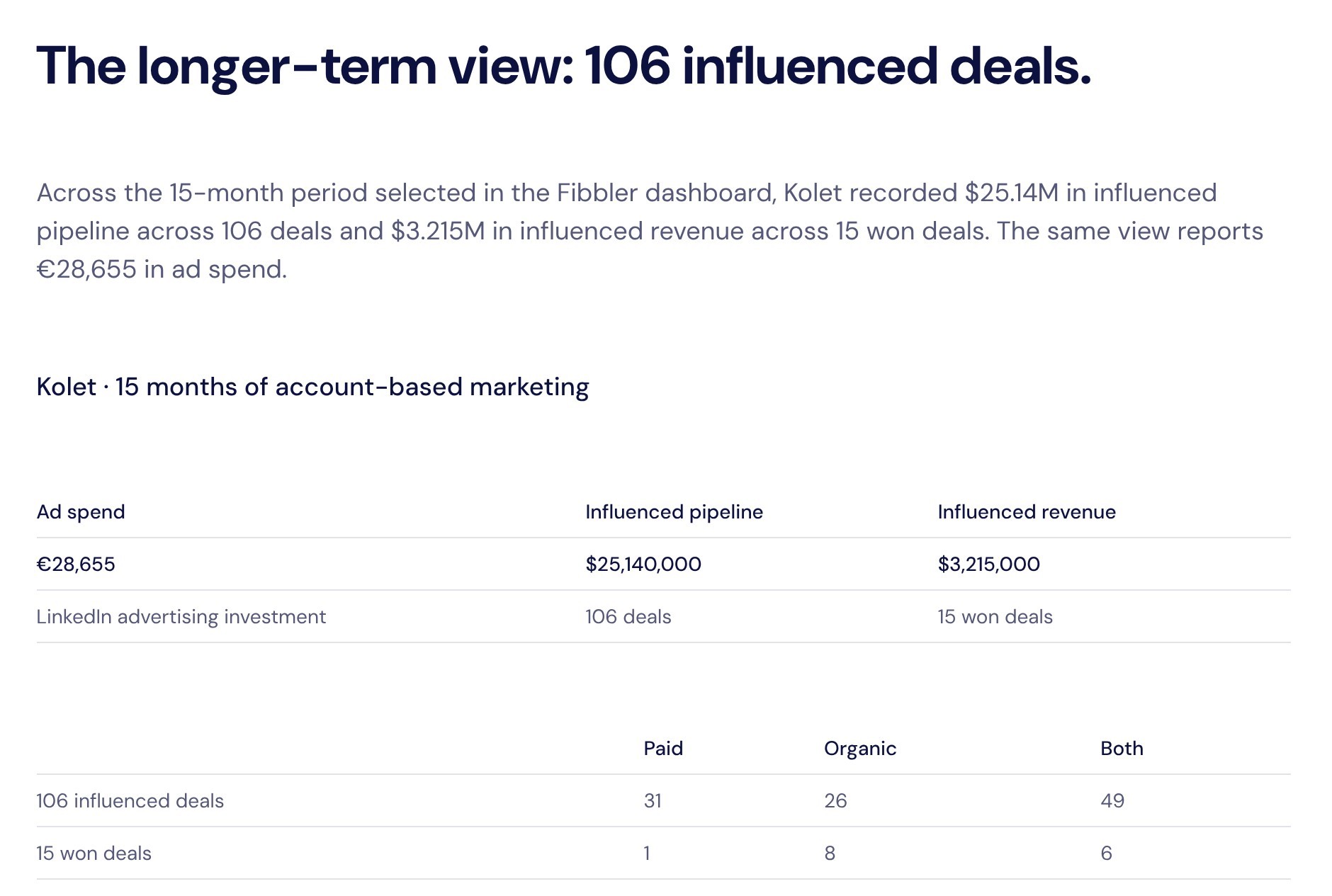
- For Kolet, an eSIM provider selling to airlines, this approach was part of a program with $25.14M in influenced pipeline from €28,655 in LinkedIn ad spend over 15 months.
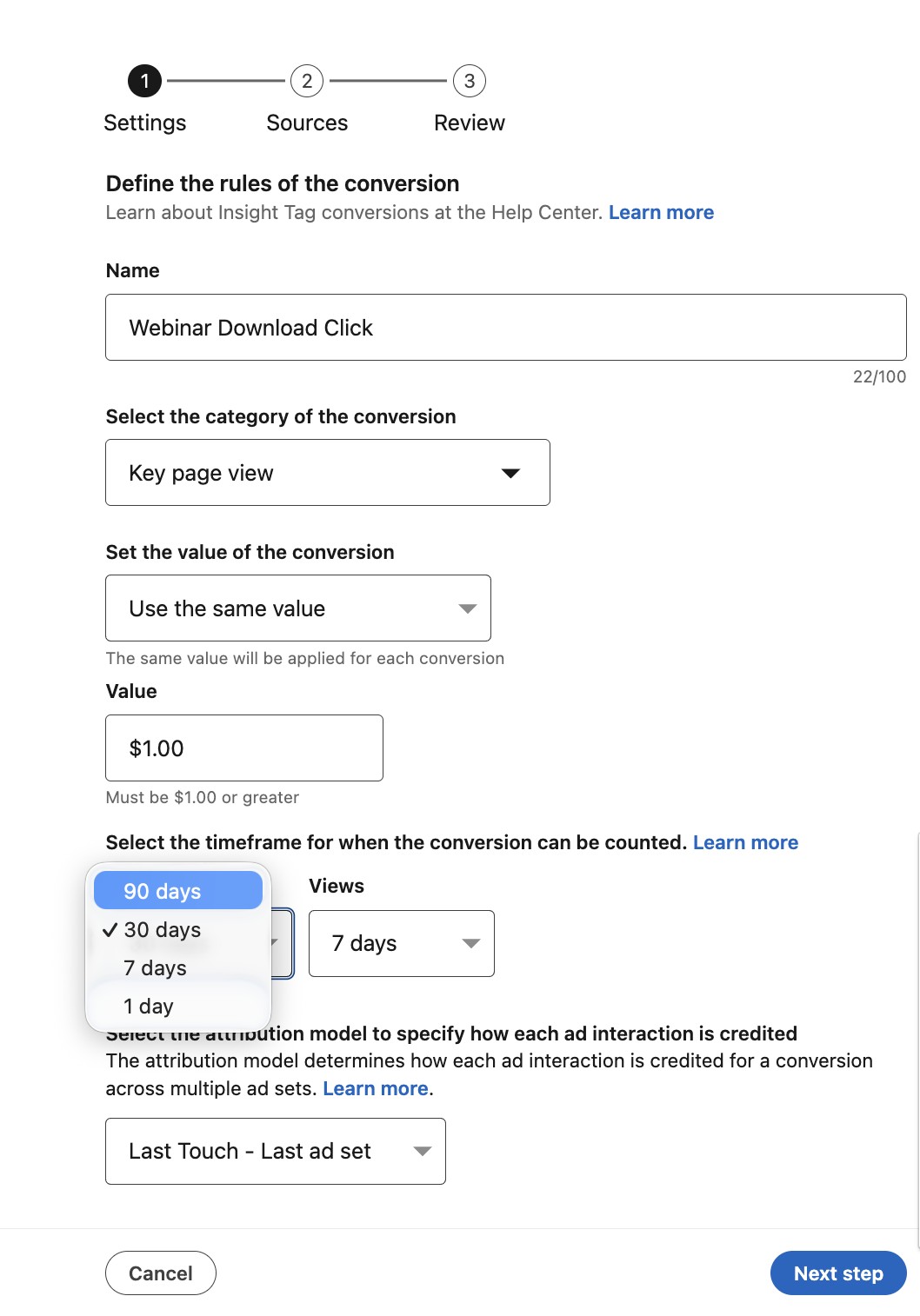
- Ad platforms can't show this. LinkedIn's longest click attribution window is 90 days, and B2B deals often take much longer.
What Is Top of Funnel in B2B?
Top of funnel (TOFU) in B2B is the stage where a company has a problem but isn't looking for a solution yet. Often they don't even see the problem. Marketing at this stage isn't about collecting leads. It's about helping the right accounts recognise the problem, and remember who explained it to them.
Before, Demand Was Waiting for Someone to Fill the Gap
A few years ago the game looked different. Demand was already there. People were searching Google for solutions every day. The hype around new categories created demand by itself, and the real problem was supply. Product development was slower than the market. Software was slower than the demand. Good people were expensive, often overpaid, because everyone needed them.
So the strategy was simple: expand horizontally. New market, new country, new vertical. Show up where people were already looking and you got your share.
Now It's the Opposite
Today the hype is still there, but it does something different. It creates confusion. It distracts people from the actual purpose. Every week there's a new AI tool, a new platform, a new "this will replace your team." There is enough software out there to fill almost any gap before you even show up.
Buyers feel it. On calls, prospects tell me they're confused. They see ten tools that claim to do the same thing, and they don't know which problem they should solve first.
I see the same thing on the team side. The teams doing best right now are the stable ones. They're not overwhelmed by AI. They know it exists, they use it, and they plan strategically how it can improve what they already do. The worst teams try something new every week, without a line or a vision on the horizon telling them where they're going.
So instead of expanding, we need to shrink and focus. Not on the small group that's ready to buy today, but on the big group that has the problem and isn't ready yet. That takes time. You need time to spread the top of the funnel, explain things, and show people the problem they have.
Why Does B2B Marketing Feel So Hard Right Now?
The research has a name for this. Professor John Dawes of the Ehrenberg-Bass Institute described the 95:5 rule, which LinkedIn's B2B Institute made popular: in most B2B categories, only around 5% of buyers are in-market at any moment. In some of the markets we work in, honestly, it feels closer to 2%.
That's the reason the market feels so hard for marketers. Everyone is trying to hit that same 2%, and everyone is doing it the same way. Same conversion objectives, same intent data, same "book a demo" ad, same retargeting. So the one buyer who is actually shopping this month sees six vendors saying almost the same thing in the same week. CPLs go up, the messages blur together, and the buyer picks whoever already made sense to them before they started shopping.
Les Binet and Peter Field's research on B2B effectiveness points the same way. B2B brands that grow over the long term put a big part of their budget, close to half, into brand building, not only into activation.
What Does Demand Actually Look Like?
I like to explain this with a simple example. A garage caught fire in my city. After that, other garages in the city center started investing in cameras, security systems and fire protection. Nobody ran an ad campaign. The fire did the marketing.
Same with banks. When one bank has to shut down because it didn't handle risk and security properly, every other bank suddenly calls a cybersecurity company. In theory the demand was always there. The event made it real.
That's what demand is: a problem that became visible, close and urgent.
As marketers we can't wait for the fire, and of course we can't start one. But we can do the next best thing, which is to make the risk visible before it happens. In today's world you can create urgency. You have to go beyond the traditional stuff and make the problem look real and close to the buyer. And here's the important part: you create the demand on the side, not directly. In that moment you're not selling your product. You're showing them the problem, and then your solution fills the gap.
First, Tell People They're Not Drinking Enough Water
Here's an example from outside B2B that makes it very clear. Imagine a sugar-free drink brand. Nothing too sophisticated. There are many other drinks without sugar on the shelf. Maybe the quality is better, maybe the branding is nicer, but on the shelf they all look similar.
If that brand opens with "buy our drink," it's one more bottle in the fridge. But if it first tells people they're not drinking enough water during the day, and shows what that does to their energy and focus, now there's a problem. And the drink becomes the easy answer to it.
Most brands skip that first step and go straight to the product. B2B is no different. We jump to the demo before the buyer even agrees they have a problem.
How We Did It for Kolet
We did exactly this for Kolet, an eSIM provider, together with our GTM partners at frontBrick. The audience was airline directors and decision-makers. The thing is, they weren't aware that across their fleets and their passengers they needed an eSIM provider. For them it simply wasn't a topic. And it's actually a big and important step, not only for airlines but across other sectors too.
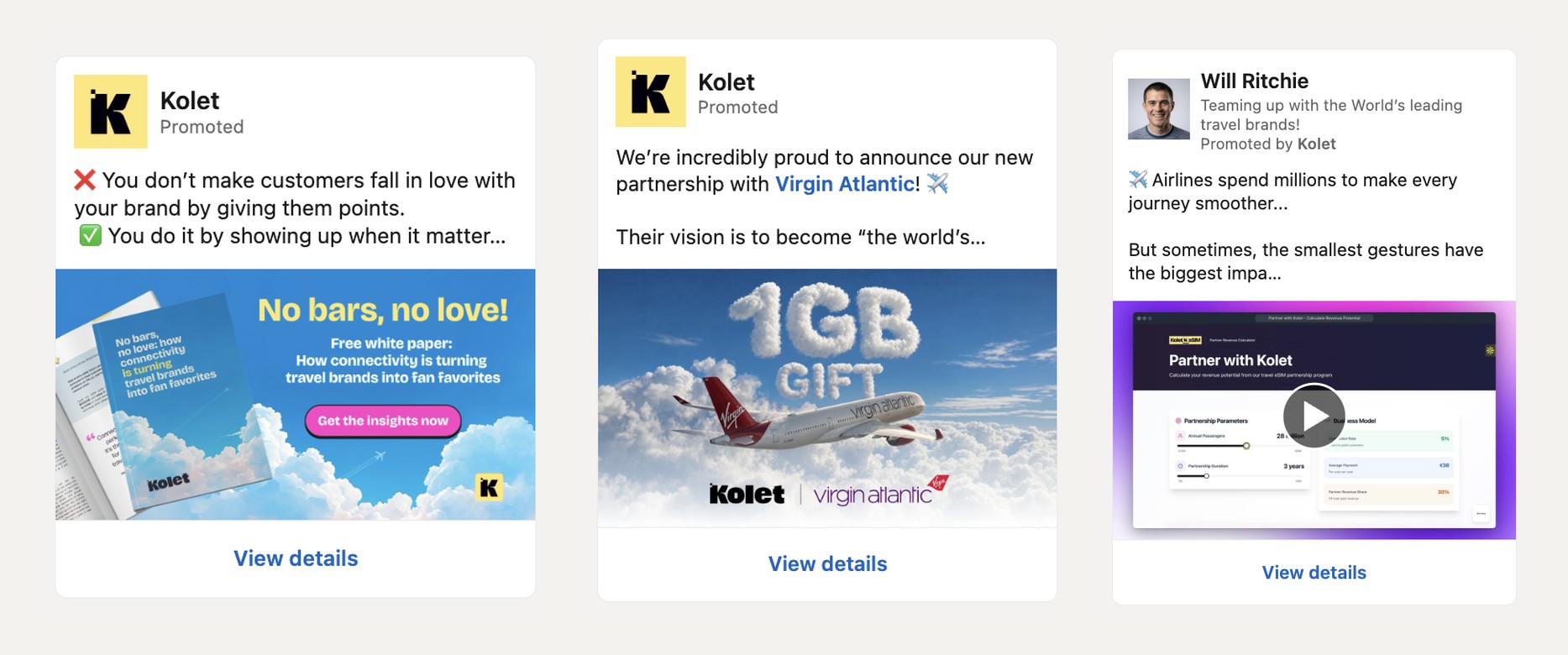
So we didn't run "partner with us, book a call." We started with the problem and with proof. One ad offered a free white paper, "No bars, no love", about how connectivity is turning travel brands into fan favorites. No product pitch, just the problem airlines were missing. Another showed Kolet's partnership with Virgin Atlantic, a plane flying past a "1GB gift" written in the clouds, so other airlines could see the idea already working at a brand they know. And for accounts that were further along, a short video from the Kolet team walking through a partner revenue calculator, so they could see what it means in money.
Then people started figuring it out themselves. "Okay, this would make sense." And in that moment, when the idea was already in their heads, we reached out.
Over 15 months, Kolet's Fibbler reporting shows €28,655 in LinkedIn ad spend, $25.14M in influenced pipeline across 106 deals, and $3.215M in influenced revenue across 15 won deals (full case study on frontBrick). These are influenced numbers, not sole-source attribution. And that's exactly the point: 49 of those 106 deals had both paid and organic engagement. Brand, content and outreach worked together.
It wasn't clever targeting. Anyone could have targeted the same people. The difference was that we gave decision-makers a problem worth caring about before we asked them for anything.
The Middle and the Bottom Still Matter
I don't want anyone to read this as "stop doing performance." The middle of the funnel is honestly the easiest part. Those buyers are active, they know the problem, and they're comparing options. Case studies, white papers, webinars and solution pages work really well there, because the buyer is looking for exactly that.
The bottom of the funnel is where everyone is queueing. A lot of that habit comes from Meta. For years Meta taught advertisers to pick a conversion objective, give the algorithm a budget and let it find buyers. On Meta that often still works, because Meta can create demand almost from nothing. Other platforms don't work like that. Google captures demand that already exists. LinkedIn gives you precision, at a premium price. When you bring Meta habits to LinkedIn, you pay premium prices to show a "book a demo" button to people who have no reason to book anything.
And yes, on LinkedIn we can now target the exact decision-makers at the exact companies we want. That's a big shift, and it saves a lot of budget. But you can still reach the right person with the wrong message. Precision decides who sees your ad. It doesn't decide what that person is ready to hear.
"But I Need Clients Right Now"
I hear this all the time, and it's fair. Nobody can wait a year.
So I'm honest with clients. There are tactics we can test very quickly, sometimes in just seven days. Over time, with good setups in place (proper tracking, good creatives, and the process done properly) you can harvest the people who are already in-market and expect results.
But if you want more than that, if you want to grow and not just collect what's already there, you need to think very carefully about brand awareness, about creativity, and about the content you're putting out there. That's where scale comes from.
How Do You Prove Top of Funnel Works?
The biggest objection to top of funnel is always "how do I know it's working?" It's a fair question, and this is where most of the problem sits.
Ad platforms only credit a conversion if it happens inside their attribution window. On LinkedIn, the longest attribution window is 90 days. After that, the touch is basically invisible, and most of what happens between the first click and the last one is missing too. For a B2B deal with a long sales cycle, 90 days is not a long enough period to attribute anything. So brand campaigns look like they did nothing, and the budget gets cut.
We use tools like Fibbler, which connects LinkedIn ad impressions to the accounts and deals in your CRM. My favourite moment is when I can take a screenshot and show the client one deal. Here's a real one.
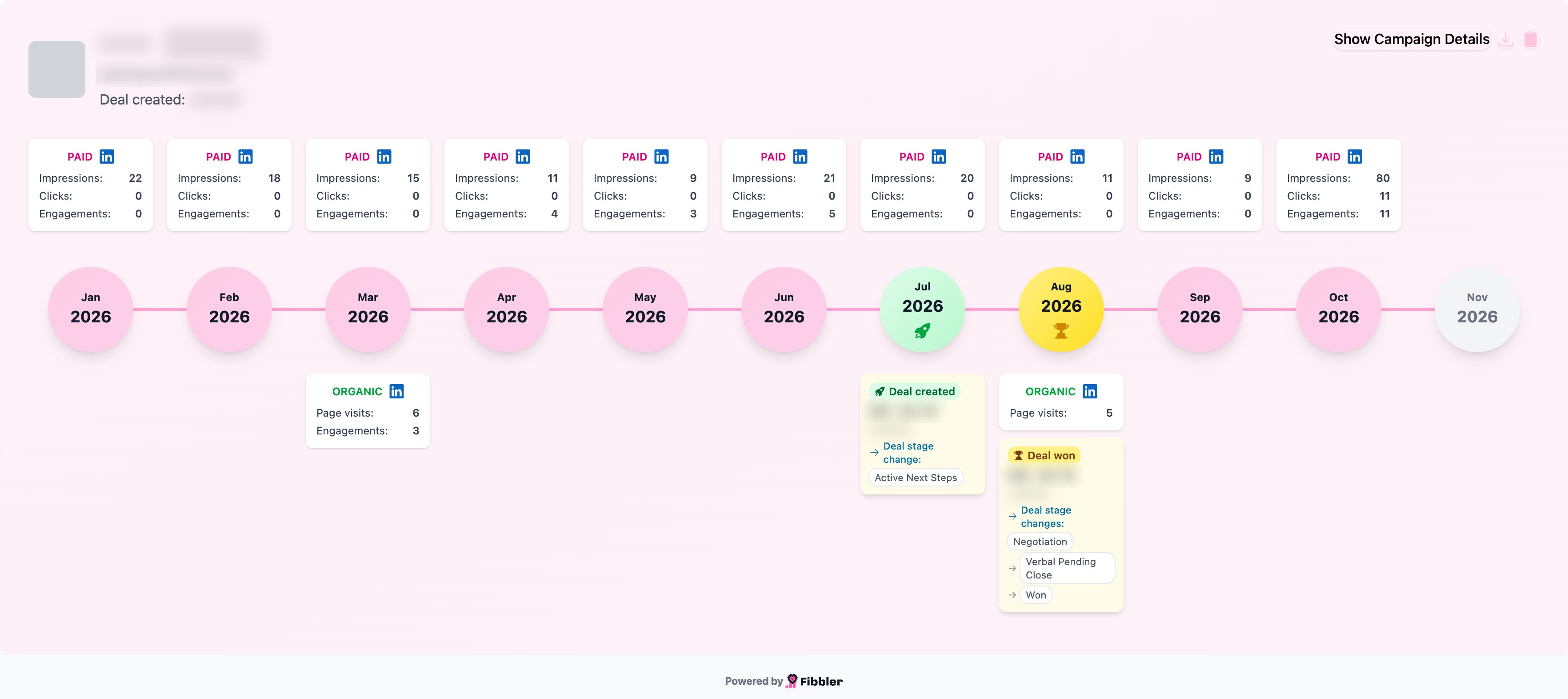
From January to June 2026, this account saw our LinkedIn ads every single month. 96 impressions and not one click. In July the deal was created. In August it was won. Until the deal was won, nobody from that account clicked a single ad.
With click-based, last-touch attribution, LinkedIn gets zero credit for that deal. In Fibbler you see the whole story. And this is a short one. Many deals take much longer to convert, and then again a long time to close, and that's totally normal.
That's clear ROI. It just doesn't fit in a 90-day window, and if you only look at the platform dashboard, you'll never see it.
What I'd Change on Monday
If I had to give one piece of advice, it would be to shift the approach. Businesses rely a lot on traditional and technical expertise: setups, bidding, audiences, dashboards. That's important, but everyone has it now. Everyone has the data. Everyone follows the same best practices.
If you're one of the same, there's no difference between you and the next company. What makes the difference now is creativity, blended with performance marketing and data. You need both.
That's also why I think big companies, instead of trying to hire everything internally, should look at agencies. Yes, I run an agency, so take this with a grain of salt. But agencies see many clients and many markets, so they bring different angles. Some ideas will be stupid. A lot of them will be bad. But from there you can pull out the creativity and build something nobody else was thinking about, on top of the huge systems and tools we all have now.
I really believe agencies, the ones that are constantly changing, will adapt to this new world better than anyone. And that's a huge opportunity for everyone who works with them.
The Bottom Line
The funnel isn't dead and the playbooks still work. But the market flipped. Before, demand was waiting and the winner was whoever filled the gap. Now a hundred tools fill the gaps, and the winner is whoever makes the buyer see the problem first.
So stop fighting over the same 2%. Go to the people who have the problem and don't know it yet. Educate them, earn their trust, and don't sell too hard. When they're ready, you won't need to convince them. You'll already be the answer.
FAQ
Q1. Is top of the funnel still important in B2B marketing?
Yes, more than before. With so many tools filling every gap, B2B demand increasingly has to be created. Top-of-funnel campaigns help buyers recognise a problem before they start comparing vendors, which is where the shortlist is really decided.
Q2. What is the 95:5 rule in B2B?
It's the finding from Professor John Dawes of the Ehrenberg-Bass Institute, popularised by the LinkedIn B2B Institute, that only around 5% of potential B2B buyers are in-market at any given time. The other 95% won't buy for months or years.
Q3. How do you create demand when buyers don't see a problem?
Make the problem visible and concrete before you talk about your product. Show the risk, the gap or the change in their customers' behaviour, and let your solution become the natural answer. Educate first and keep the hard sell out of it.
Q4. Why don't ad platforms show the impact of brand campaigns?
Platforms only credit conversions inside an attribution window, and on LinkedIn the longest is 90 days. B2B sales cycles are often much longer, so earlier touches disappear. Tools that connect ad impressions to CRM accounts, like Fibbler, plus account-level metrics, show the real impact.
Q5. How long does B2B top of funnel take to show results?
Early signals such as engaged ICP accounts and website visits from target companies can show up within weeks. Pipeline usually takes much longer. In one of our won deals, the account saw our LinkedIn ads for six months without a single click before the deal was created. Longer cycles are normal.
Want a Second Opinion on Your Top of Funnel?
If most of your budget is going into the same 2% everyone else is chasing, it might be worth looking at what your top of funnel is actually saying.
We help B2B companies build campaigns that make buyers see the problem first, then turn that attention into pipeline on LinkedIn, Google and Meta. It's where our brand strategy and paid social and paid search work meet.
Talk to us about your top of funnel →
About the Author
Luka Dolic is the founder and CEO of OSA Digital, a B2B growth marketing agency based in Belgrade, Serbia. He works with B2B companies across the EU and US on LinkedIn, Google and Meta advertising, account-based marketing and AI-powered marketing operations.


